Seismic Suitability Clarification: IEEE 693 (High Performance) vs. Zone 5 Standards Here is the technical justification and referencing framework for IEEE 693 (High Performance) vs. Zone 5 Standards 1. The Core Justification: Peak Ground Acceleration (PGA) Seismic severity is scientifically quantified by “Peak Ground Acceleration (PGA)” or Zero Period Acceleration (ZPA), measured in units of …

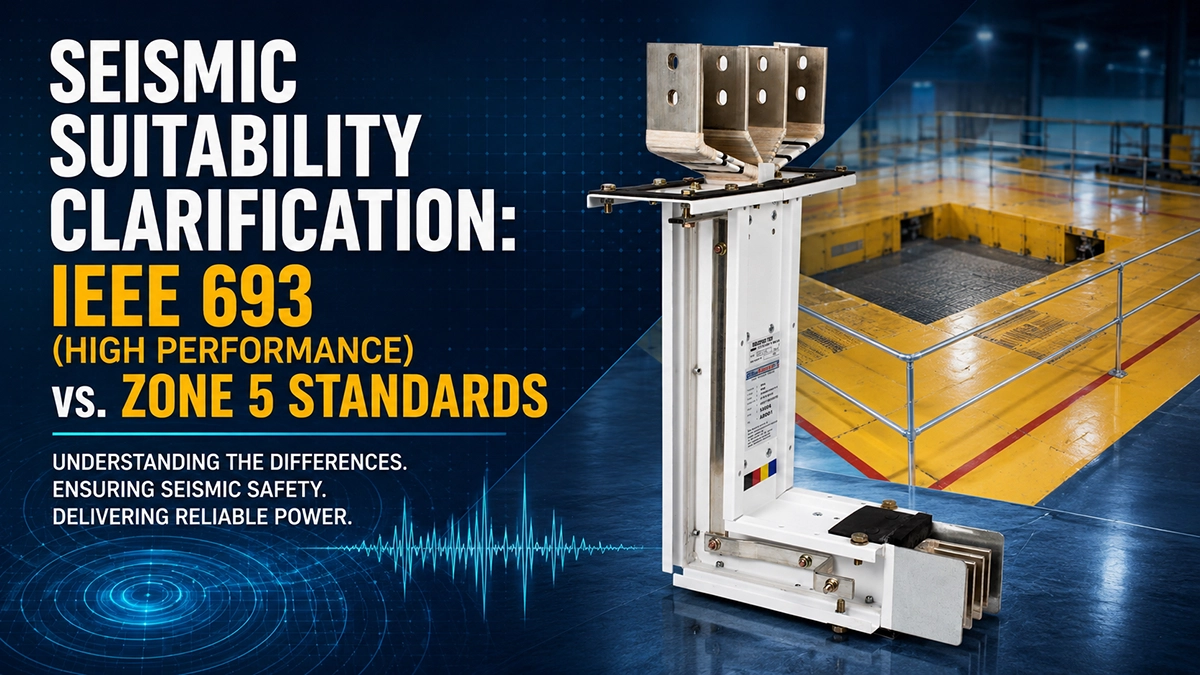
Seismic Suitability Clarification: IEEE 693 (High Performance) vs. Zone 5 Standards
Here is the technical justification and referencing framework for IEEE 693 (High Performance) vs. Zone 5 Standards
1. The Core Justification: Peak Ground Acceleration (PGA)
Seismic severity is scientifically quantified by “Peak Ground Acceleration (PGA)” or Zero Period Acceleration (ZPA), measured in units of gravity (g). Comparing the two standards reveals that IEEE 693 High Performance Level mandates significantly higher forces.
* “National Code Zone 5:” The maximum considered zone factor (effective peak ground acceleration) for the highest seismic risk area (Zone 5) is “0.36g”.
* “IEEE 693:2018 High Performance Level:” This standard requires testing to a much higher “ZPA of 1.0g” for the physical shake table test (which corresponds to a “0.5g” High Design Ground Motion multiplied by a factor of 2 to verify structural and functional margins).
> “Conclusion:” The busducst physically tested to withstand accelerations (1.0g) that are “nearly three times higher” than the baseline ground acceleration expected in a Zone 5 earthquake (0.36g).
2. Technical Comparison Matrix
| Zone / Level Focus | Civil structures & building safety | Critical electrical infrastructure function |
| Peak Ground Acceleration (PGA) | 0.36g | 1.0g (Shake Table Input) |
| Required Response Spectrum (RRS) Peak | ~ 0.9g to 1.0g (at 5% damping) | 2.5g (at 2% damping, 1.1–8.0 Hz) |
| Testing Methodology | Primarily mathematical/analytical calculation | Triaxial Dynamic Shake Table Testing (Physical) |
| Post-Event Performance | Prevent structural collapse; allows internal damage | Fully Functional immediately after the event |
3. Justification Points for Engineering Proposal
A. The “Survival” vs. “Operational” Philosophy
Building codes for Zone 5 are designed for civil safety—ensuring a building does not collapse so occupants can escape. However, internal components (like busducts) can still deform, short circuit, or fail operationally under those rules.
Conversely, “IEEE 693 is a rigorous survival and operational standard.” Qualifying for the High Performance Level ensures that the sandwich busduct maintains its “structural integrity AND electrical functionality” during and immediately after a severe seismic event.
B. Severe Response Spectrum Amplification
In an earthquake, the real danger to a busduct is resonance. IEEE 693:2018 tests equipment using a “Required Response Spectrum (RRS)” that peaks at “2.5g” in the critical frequency band of 1Hz to 50 Hz (where most structural resonances occur). Standard Zone 5 calculations do not subject equipment to such severe spectral acceleration peaks.
C. Addressing the “Richter Scale ” Misconception
Consultants are often skeptical of claims like “withstands Richter scale 9” because the Richter scale measures energy at the earthquake’s epicentre, not the localised acceleration (g-force) hitting the equipment.
While a Richter magnitude 9 earthquake translates to varying localised forces depending on distance, IEEE 693:2018 High Performance Level specifically tests for a localised ZPA of 1.0g and an RRS peak of 2.5g. This is mathematically equivalent to the absolute worst-case near-fault ground motions recorded globally—well exceeding standard Zone 5 envelope demands.”
4. Formal Reference Text
> “Clarification on Seismic Suitability Compliance:”
> According to standard building seismic zoning regulations (such as IS 1893 / UBC), Zone 5 represents a peak ground acceleration factor of “0.36g”. In contrast, IEEE 693:2018 High Performance Level dictates a mandatory Zero Period Acceleration (ZPA) of “1.0g” and a peak Required Response Spectrum (RRS) of “2.5g” under triaxial shake table testing.
> Because the test parameters of IEEE 693 High Performance Level envelop the peak acceleration profiles of Zone 5 by a safety factor of more than 2.5x, the system is inherently and fully compliant for installation in any Zone 5 application. Test certificates and independent test lab reports can be furnished upon request.”
Reference: Paper presented at 16th European Conference on Earthquake Engineering (18-21 June, 2018) by Dr. Christos KOTANIDI, Anastasia PALAIOCHORINOU, Dr.-Ing. Hermann KOCH