Modern data centers require power distribution that scales with changing loads and architectures. This article explores engineering principles, architectural choices, and lifecycle strategies that enable flexible, reliable, and downtime-free power scalability for phased data center growth.

Executive Summary
Data centers are no longer static facilities designed around fixed load assumptions. Rapid shifts in compute density, cooling architecture, redundancy requirements, and deployment timelines demand power distribution systems that can scale without compromising uptime or safety. Traditional approaches that optimize only for initial capacity often create bottlenecks during expansion, leading to downtime, rework, and elevated operational risk. This article examines the engineering principles behind scalable power distribution for data centers, focusing on architectural choices, system flexibility, and lifecycle performance required to support phased growth and evolving load profiles.
1. Why Scalability Is a Core Design Requirement in Data Centers
Data center power demand evolves continuously due to:
- Increasing rack power density
- Transition to AI and high-performance compute loads
- Modular expansion strategies
- Changing redundancy and availability targets
Scalability is not simply the ability to add capacity. It is the ability to do so predictably, safely, and without disrupting live operations.
2. Limitations of Capacity-First Power Distribution Design
Designs focused solely on day-one capacity often encounter challenges such as:
- Congested cable pathways
- Limited access for expansion
- Thermal derating under increased load
- Inflexible routing in vertical and horizontal distribution
These constraints typically emerge after commissioning, when modifications become costly and disruptive.
3. Power Distribution Architecture in Modern Data Centers
A scalable data center power architecture typically includes:
- Utility and backup power sources
- Medium-voltage and low-voltage transformation
- Main and sub-distribution systems
- Final distribution to IT loads
Scalability must be engineered across all layers, with particular attention to low-voltage distribution where expansion occurs most frequently.
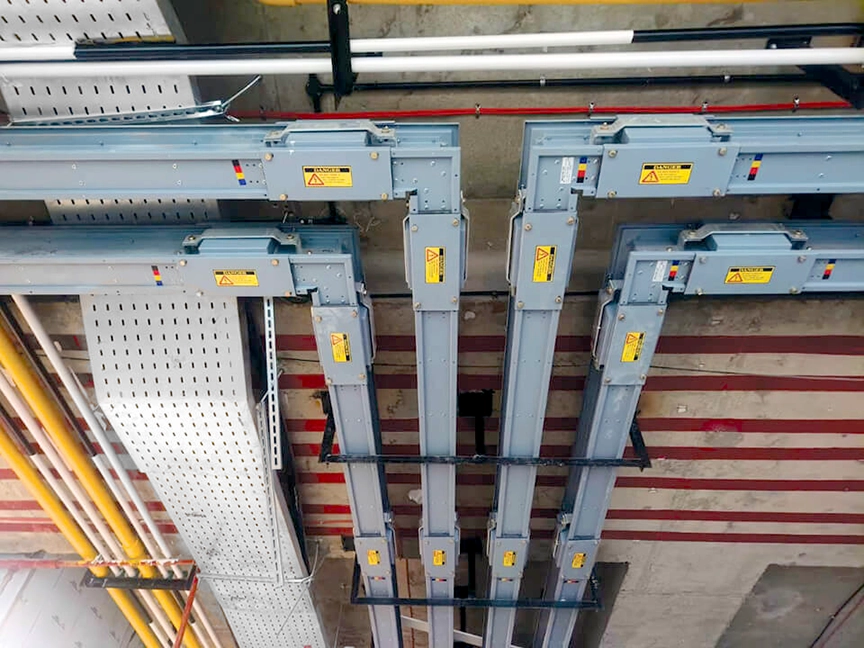
4. Role of Busduct Systems in Scalable Architectures
Busduct systems offer structural advantages in data center environments due to:
- Modular construction
- Compact footprint
- Predictable electrical and thermal behavior
- Support for phased expansion
Sandwich busduct systems are especially well suited for current ratings commonly used in data center distribution, enabling controlled growth without extensive rework.
5. Electrical Design Considerations for Scalability
Key electrical parameters influencing scalability include:
- Low impedance paths to minimize voltage drop during load increase
- Phase balance to support uneven growth patterns
- Short-circuit withstand capability aligned with future fault levels
Design margins must account for both steady-state and transient loading conditions.
6. Thermal Predictability Under Growing Load Density
As load density increases:
- Heat dissipation becomes more challenging
- Localized hot spots increase failure risk
- Insulation ageing accelerates
Scalable systems maintain predictable temperature rise even as loads approach upper design limits, preserving reliability and safety margins.
7. Mechanical and Spatial Flexibility
Data centers demand power distribution systems that:
- Support vertical risers and overhead distribution
- Allow rapid routing changes
- Minimize floor and ceiling congestion
Rigid, modular systems reduce dependency on site-specific improvisation and enable consistent execution across phases.
8. Expansion Without Downtime
One of the most critical scalability requirements is the ability to expand without interrupting live operations.
Engineering strategies include:
- Planned tap-off points
- Modular section additions
- Clear segregation of live and expansion zones
Systems that require shutdowns for modification introduce unacceptable operational risk in mission-critical environments.
9. Redundancy and Availability Alignment
Scalability must coexist with redundancy strategies such as:
- N+1
- 2N
- Distributed redundancy models
Power distribution systems should integrate seamlessly with redundancy architecture without excessive duplication or complexity.
10. Standards and Compliance Considerations
IEC 61439-6 provides baseline safety and performance requirements for busduct systems used in data centers. However:
- Compliance does not define scalability limits
- Site-specific conditions influence real-world performance
Engineering judgement is required to design beyond minimum compliance.
11. Common Scalability Pitfalls in Data Center Projects
- Designing for current rack density only
- Underestimating future fault levels
- Ignoring thermal derating during expansion
- Treating power distribution as static infrastructure
These oversights often force premature system replacement or extensive retrofits.
12. Decision Framework for Data Center Stakeholders
When evaluating scalable power distribution solutions, assess:
- Expansion flexibility without shutdown
- Electrical and thermal margin under future loads
- Mechanical adaptability to layout changes
- Vendor engineering capability and test discipline
- Alignment with redundancy strategy
A structured framework reduces long-term risk.
Frequently Asked Questions
What makes a power distribution system scalable for data centers?
Scalability requires modular design, predictable performance under increased load, and the ability to expand without disrupting live operations.
Are cable systems suitable for scalable data centers?
Cable systems become complex and constrained as density increases, making scalability difficult beyond moderate current levels.
Why are sandwich busduct systems commonly used in data centers?
They offer compact design, controlled thermal behavior, and modular expansion capability suited for high-density environments.
Does compliance with IEC 61439-6 ensure scalability?
Compliance ensures safety, but scalability depends on system architecture and engineering margin.
Can scalability be retrofitted later?
Retrofitting is costly and risky. Scalability must be designed into the system from the outset.
Conclusion: Scalability Is an Engineering Outcome
Scalable power distribution in data centers is not achieved through excess capacity alone. It is the result of disciplined engineering, modular architecture, and lifecycle-focused decision-making. Systems designed for predictable expansion protect uptime, reduce operational risk, and support long-term growth. Treating scalability as a core design objective ensures that power infrastructure evolves with the data center rather than constraining it.
Tags:blogs