IEC 61439-6 defines minimum safety and performance requirements for busbar trunking systems. This article explains its intent, scope, and limitations, helping consulting engineers apply the standard effectively within broader design, reliability, and risk-management frameworks.

Executive Summary
IEC 61439-6 is the governing international standard for busbar trunking systems and serves as the primary reference point for safety, performance, and verification requirements. For consulting engineers, understanding what this standard covers and, equally important, what it does not cover is critical to effective specification and risk management. While IEC 61439-6 establishes minimum acceptance criteria for busduct systems, it does not by itself guarantee long-term reliability, thermal stability, or execution predictability in real-world installations. This article explains IEC 61439-6 from a consulting engineer’s perspective, clarifying its intent, scope, limitations, and how it should be applied within a broader engineering decision framework.
1. Why IEC 61439-6 Matters in Modern Power Distribution
As power distribution systems scale in current, complexity, and criticality, prescriptive standards become essential to ensure baseline safety and interoperability. IEC 61439-6 provides:
- A harmonized framework for busduct system design
- Common terminology for manufacturers, consultants, and inspectors
- Defined verification requirements for safety and performance
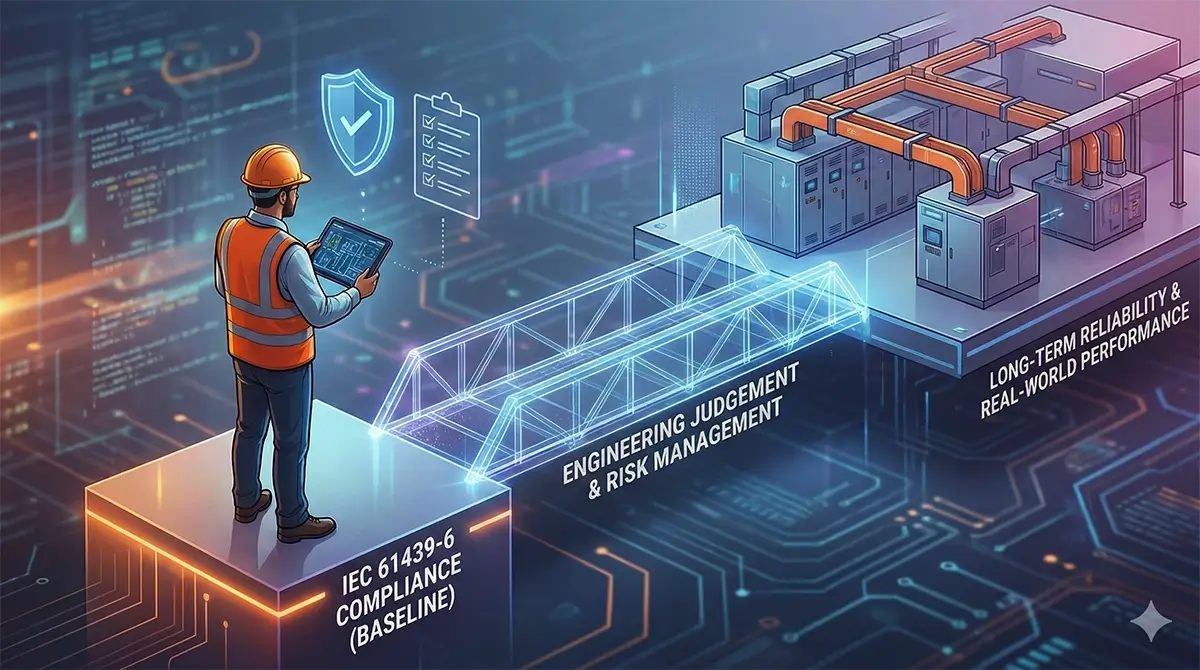
For consulting engineers, the standard functions as a risk floor, not a performance ceiling.
2. Where IEC 61439-6 Fits Within the IEC 61439 Series
IEC 61439 is a multi-part standard covering low-voltage switchgear and controlgear assemblies.
Relevant structure
- IEC 61439-1: General rules
- IEC 61439-6: Busbar trunking systems
IEC 61439-6 must always be read in conjunction with IEC 61439-1. The general rules define verification principles, while Part 6 applies them specifically to busduct systems.
3. Scope of IEC 61439-6
IEC 61439-6 applies to:
- Low-voltage busbar trunking systems
- Rated voltages up to 1000V AC
- Systems intended for power distribution
It covers aspects such as:
- Electrical characteristics
- Mechanical construction
- Thermal performance
- Dielectric properties
- Short-circuit withstand capability
The standard does not address site-specific application risks or lifecycle performance beyond defined test conditions.
4. Key Performance Requirements Defined by the Standard
Temperature Rise Limits
The standard specifies maximum permissible temperature rise for:
- Conductors
- Insulation
- Enclosures
These limits ensure safe operation under defined test conditions.
Dielectric Properties
Verification ensures:
- Adequate insulation resistance
- High-voltage withstand capability
Short-Circuit Withstand Strength
Busduct systems must demonstrate the ability to withstand:
- Thermal stress from fault currents
Mechanical forces during short-circuit events
Mechanical Strength
Includes resistance to:
- Impact
- Deformation
Assembly-related stress
5. Verification Methods Under IEC 61439-6
The standard allows three primary verification approaches:
- Design verification by testing
- Design verification by calculation
- Design verification by comparison with a reference design
For consulting engineers, understanding which method has been used is critical. Testing provides the highest confidence, while calculation and comparison require careful scrutiny of assumptions and equivalency.
6. Routine Verification vs Design Verification
IEC 61439-6 distinguishes between:
Design Verification
- Performed on representative system designs
- Validates thermal, electrical, and mechanical performance
Routine Verification
- Performed on every manufactured system
- Confirms workmanship, continuity, and insulation integrity
A system can be design-verified yet still fail in service if routine verification discipline is weak.
7. What IEC 61439-6 Does Not Guarantee
This is where consulting engineers must exercise judgement.
IEC 61439-6 does not guarantee:
- Long-term thermal stability under site-specific conditions
- Installation quality or joint assembly discipline
- Performance under future expansion scenarios
- Lifecycle reliability beyond tested configurations
Compliance ensures safety thresholds are met, not that the system is optimized for every application.
8. Common Misinterpretations by Specifiers
- Assuming compliance equals reliability
- Treating test certificates as interchangeable across configurations
- Ignoring differences in joint design and manufacturing discipline
- Overlooking the impact of installation environment on thermal behavior
These assumptions can expose projects to latent operational risks.
9. How Consulting Engineers Should Use IEC 61439-6 in Specifications
IEC 61439-6 should be used as:
- A baseline compliance requirement
- A reference for verification documentation
- A starting point for deeper technical evaluation
Specifications should additionally address:
- Temperature rise margins
- Joint design philosophy
- Manufacturing and testing discipline
- Application-specific performance expectations
10. Integrating IEC 61439-6 with Engineering Judgement
Effective specification combines:
- Standards compliance
- Application context
- Lifecycle considerations
- Vendor engineering capability
Consulting engineers add value by interpreting standards through the lens of real-world operating conditions rather than treating them as checkbox requirements.
11. Practical Checklist for Consulting Engineers
When reviewing a busduct system proposal, verify:
- Which verification methods were used
- Temperature rise data under representative loading
- Short-circuit test ratings and configurations
- Routine testing procedures
- Documentation and traceability
This ensures compliance translates into dependable performance.
Frequently Asked Questions
Is IEC 61439-6 mandatory for all busduct systems?
In most regions, it is the accepted international reference standard for low-voltage busbar trunking systems.
Does compliance ensure system reliability?
Compliance ensures safety and baseline performance, but long-term reliability depends on design margins, testing discipline, and application suitability.
Can test results be extrapolated across all configurations?
Only within defined limits. Consulting engineers should confirm equivalency assumptions carefully.
Is design verification sufficient on its own?
No. Routine verification is equally critical to ensure manufacturing consistency.
Should specifications go beyond IEC 61439-6?
Yes. Project-specific requirements often demand higher performance margins than the standard minimums.
Conclusion: Thermal Discipline Enables Long-Term Reliability
IEC 61439-6 provides a vital framework for safe busduct system design and verification. However, its true value lies in how it is interpreted and applied by consulting engineers. When combined with sound engineering judgement, disciplined manufacturing, and application-specific evaluation, the standard becomes a powerful tool for delivering reliable, scalable power distribution systems. Treating compliance as the starting point rather than the finish line is key to long-term infrastructure performance.
Tags:blogs