Thermal performance is critical to power distribution reliability at high load densities. This article explains thermal failure mechanisms, limits of conventional systems, and engineering strategies that ensure predictable heat dissipation and long-term stability in high-current environments.

Executive Summary
Thermal performance is one of the most decisive yet underestimated factors in power distribution system reliability. As electrical load densities increase in industrial plants, data centers, and infrastructure projects, thermal stress becomes a primary driver of insulation degradation, joint failure, and unplanned downtime. High-density power systems demand predictable heat dissipation, stable temperature rise, and controlled fault behavior across their lifecycle. This article examines the fundamentals of thermal management in high-current power distribution, explains why conventional approaches fail at scale, and outlines engineering strategies that ensure long-term thermal stability in high-density environments.
1. Why Thermal Management Has Become a Critical Design Variable
Modern power systems operate under conditions that amplify thermal stress:
- Higher current ratings within compact footprints
- Reduced airflow due to space optimization
- Continuous or near-continuous loading
- Higher ambient temperatures in enclosed environments
In such conditions, even small thermal inefficiencies compound over time. Thermal mismanagement rarely causes immediate failure. Instead, it accelerates insulation ageing, weakens joints, and reduces system tolerance to transient overloads and fault events.
2. Understanding Heat Generation in Power Distribution Systems
Heat in power distribution systems is primarily generated due to resistive losses.
Key contributors
- Conductor resistance under load
- Contact resistance at joints and terminations
- Magnetic effects from conductor geometry
- Harmonics and load imbalance
As current increases, resistive losses increase proportionally to the square of the current. This makes thermal behavior non-linear and increasingly difficult to manage at higher current densities.
3. Thermal Limitations of Conventional Cable-Based Systems
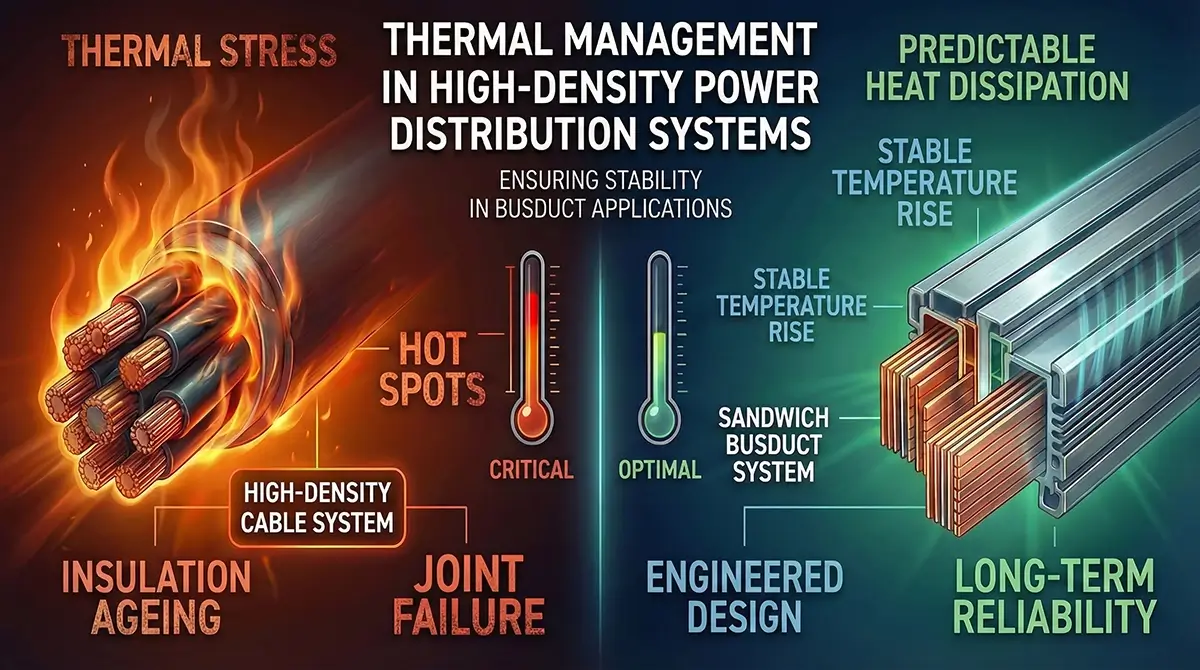
Cable systems rely heavily on environmental conditions for heat dissipation.
Challenges in high-density installations
- Cable bundling restricts airflow
- Derating becomes mandatory but is often underestimated
- Uneven heat distribution across parallel runs
- Hot spots at terminations and joints
In congested trays or vertical risers, thermal performance becomes highly variable and difficult to predict with confidence.
4. Thermal Behavior of Sandwich Busduct Systems
Sandwich busduct systems are inherently designed for controlled thermal performance.
Key thermal design characteristics
- Compact and symmetrical conductor arrangement
- Uniform insulation thickness across conductor length
- Continuous metallic enclosure aiding heat dissipation
- Reduced dependency on ambient airflow
These attributes enable predictable temperature rise under steady-state and transient loading conditions.
5. Temperature Rise and Its Impact on System Reliability
Temperature rise is not just a compliance metric. It directly influences:
- Insulation lifespan
- Joint stability
- Long-term current carrying capacity
- Safety margins during overload conditions
Systems operating closer to their thermal limits experience accelerated degradation, even if they remain within nominal ratings.
6. Role of Joint Design in Thermal Stability
Joints are the most thermally sensitive points in any power distribution system.
Common thermal risks at joints
- Increased contact resistance
- Uneven torque during installation
- Differential expansion under load
Engineering-led systems treat joints as integral thermal components, using controlled assembly processes and validated joint designs to ensure consistent performance.
7. Impact of Load Profiles and Harmonics
Modern loads introduce additional thermal complexity.
- Non-linear loads generate harmonics
- Harmonics increase effective RMS current
- Neutral conductors experience elevated heating
Thermal design must account for real operating conditions rather than idealized load assumptions.
8. Thermal Management Strategies in High-Density Systems
Effective thermal management requires a system-level approach.
Engineering strategies include
- Low-impedance conductor geometry
- Uniform insulation and spacing
- Controlled enclosure design
- Validated temperature rise testing
- Allowance for future load growth
Thermal predictability is achieved through design discipline, not post-installation correction.
9. Standards Perspective: Beyond Compliance
IEC 61439-6 specifies allowable temperature rise limits. However:
- Standards define minimum safety thresholds
- They do not predict long-term degradation
- They do not account for site-specific constraints
Engineering judgement is required to design systems that operate comfortably below thermal limits across their lifecycle.
10. Common Thermal Design Mistakes to Avoid
- Ignoring thermal derating in compact layouts
- Oversimplifying load diversity assumptions
- Treating joints as passive components
- Designing for present load without growth margin
These mistakes often surface as operational issues years after commissioning.
11. Decision Checklist for Engineers and Specifiers
Before finalizing a power distribution system, evaluate:
- Expected continuous and peak load profiles
- Ambient temperature and ventilation conditions
- Joint design and assembly controls
- Validated temperature rise data
- Expansion impact on thermal performance
Thermal stability must be designed in, not managed reactively.
Frequently Asked Questions
Why is thermal management more critical in high-current systems?
Because resistive losses increase non-linearly with current, small inefficiencies result in disproportionate temperature rise at higher current levels.
How does thermal stress affect insulation life?
Elevated temperatures accelerate insulation ageing, reducing dielectric strength and increasing failure risk over time.
Are sandwich busduct systems thermally superior to cables?
In high-density applications, yes. Their uniform conductor geometry and enclosed design provide more predictable thermal behavior.
Does IEC compliance ensure thermal reliability?
Compliance ensures safety limits but does not guarantee long-term thermal stability under real operating conditions.
Can thermal issues be corrected after installation?
Thermal deficiencies are difficult and costly to correct post-installation. Early-stage design is critical.
Conclusion: Thermal Discipline Enables Long-Term Reliability
In high-density power distribution systems, thermal management is not an auxiliary concern. It is a foundational design parameter that determines reliability, safety, and system lifespan. Engineering-led solutions that prioritize predictable thermal behavior provide a decisive advantage in mission-critical environments. Designing for thermal stability ensures that power distribution systems support growth rather than becoming a limiting factor.
Tags:blogs