Current Density ≠ Busbar Ampacity Current density (J = I/A) is widely used as a convenient starting point for busbar sizing. But can a value such as 1.0, 1.2 or 1.5 A/mm², by itself, establish the continuous ampacity of a busbar? The answer is NO.Current density is only a geometric parameter. Continuous current-carrying capacity is …

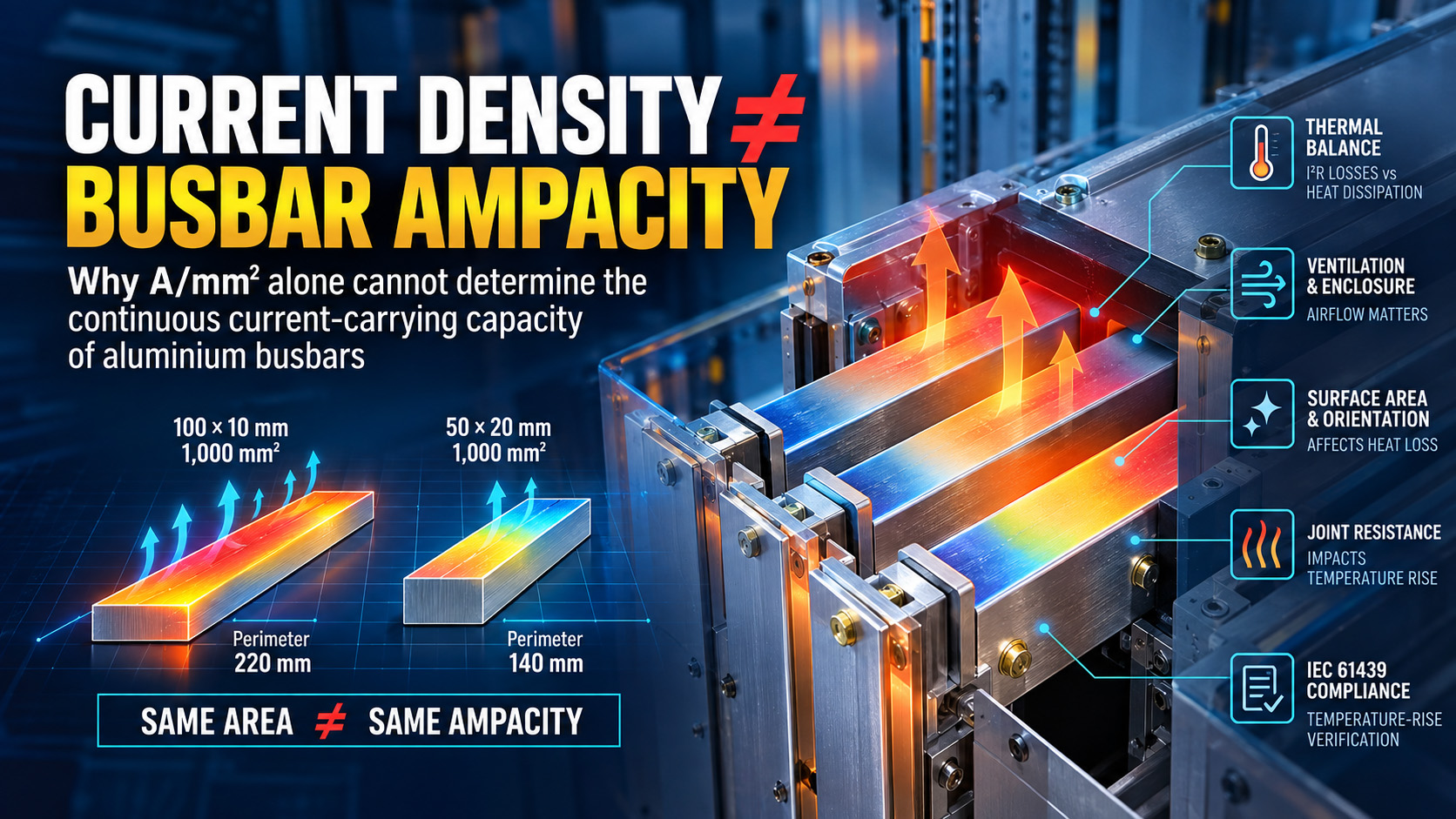
Current Density ≠ Busbar Ampacity
Current density (J = I/A) is widely used as a convenient starting point for busbar sizing. But can a value such as 1.0, 1.2 or 1.5 A/mm², by itself, establish the continuous ampacity of a busbar?
The answer is NO.
Current density is only a geometric parameter. Continuous current-carrying capacity is fundamentally a THERMAL problem.
The actual ampacity depends on the balance between heat generated by I²R losses and heat dissipated by convection, radiation and conduction.
Key factors include:
• Busbar geometry and aspect ratio
• Surface area and orientation
• Ambient temperature
• Enclosure/IP rating and ventilation
• Surface emissivity/finish
• Number and spacing of parallel bars
• Skin and proximity effects
• Joint/contact resistance
• Conductor material and temperature-dependent resistivity
A simple example from the technical analysis illustrates the point:
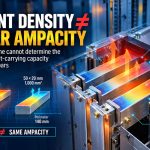
Two aluminium bars have the SAME cross-sectional area: 100 × 10 mm and 50 × 20 mm = 1,000 mm².
Yet their perimeters are 220 mm and 140 mm respectively. Under the stated thermal assumptions, the 100 × 10 mm bar has substantially greater heat-dissipation capability and a higher calculated ampacity.
Therefore:
SAME AREA ≠ SAME AMPACITY
Likewise, increasing the number of parallel bars does not increase ampacity in direct proportion to area because thermal interaction, radiation trapping and restricted convection become increasingly important.
For LV switchboards and sandwich busducts, this becomes even more important. Enclosures restrict airflow, while compact sandwich busduct construction provides essentially no internal free-air convection. Simple free-air current-density rules therefore cannot represent the complete thermal behaviour of the assembly.
The engineering approach should be:
CURRENT DENSITY
↓
Preliminary conductor selection
↓
AC resistance & losses
↓
Thermal analysis
↓
Temperature-rise verification
↓
IEC 61439 compliance
IEC 61439-1/-2/-6 focuses on temperature-rise verification of the complete assembly—not on a prescribed A/mm² value as the acceptance criterion.
The key message:
AMPACITY IS A THERMAL PROBLEM, NOT A CONSTANT CURRENT-DENSITY NUMBER.
Current density remains useful for preliminary sizing and engineering comparison. However, final busbar ratings should be supported by validated thermal calculations, appropriate derating and standards-based verification.
For switchboards and sandwich busducts, moving beyond “A/mm²” thumb rules is essential for robust engineering.